
Electric Fireplace Repair
Heater, blower, remote, or flame-effect acting up? One tech sorts it out.
Learn morePilot assemblies are a known wear item — figure roughly every eight years they get weak, dirty, or contaminated, and the smart move is replacing the whole unit at once: orifice, hood, thermocouple, thermopile, and igniter wire together, not chasing one part at a time. It's a fast, single-visit job, and since we already know your fireplace, we can fold it into a maintenance round so the ignition is reliable again without a dedicated trip.
Your fireplace has a working ignition system that's stopped proving — and this service replaces the one part that failed, on the system that's already there. The signature complaint is unmistakable: you press and hold the control knob, the pilot lights, and the instant you let go the flame goes out. That's not a mystery; it's a measurement. Texas Service Experts diagnoses it by metering the proving circuit and replaces the failed component to bring your existing ignition back — a quick, defined fix that the same crew can roll into whatever else your fireplace or chimney needs that visit, rather than a standalone service call.
There's specific physics behind that dropout. A standing pilot's thermocouple has to heat until it generates enough millivolts to hold the gas valve's safety magnet open — a healthy one reads roughly 25–30 mV open-circuit. As it weakens with age, soot, or a slightly mis-aimed flame, it still lights but can no longer make enough millivolt to hold the magnet, so the valve snaps shut the second you stop overriding it by holding the knob. We put a meter on it and read the number instead of guessing: a low reading confirms the thermocouple (or thermopile, on a millivolt system) is the part to swap — not the valve.
How this differs from pilot-light-installation: that service builds an ignition system where none works — choosing the architecture and wiring the interlock from scratch. This service keeps your existing architecture and renews a specific worn part within it. You're not redesigning how the fireplace lights; you're replacing the thermocouple, thermopile, igniter, or pilot hood that aged out of the system you already have. Installation builds; replacement renews. If you had working ignition and a part died, this is the page.
Which side of the interlock has failed is also what separates this from gas-valve work, and that distinction is the whole diagnosis. A dropping pilot can mean a weak thermocouple (this service) or, less often, a failing valve magnet that won't hold even on a healthy millivolt signal (valve service). We don't assume — we meter the thermocouple output and check the valve's hold, so we replace the cheap proving part when that's the cause rather than selling a valve. We also rule out a clogged pilot orifice or a draft pulling the flame off the sensor tip, because a new thermocouple fixes neither of those.
When the assembly really is the cause, replacement is a clean, same-day part-swap. We source the correct thermocouple/thermopile, igniter, or full pilot hood for your appliance valve so the proving circuit functions as listed, mount it so the pilot flame fully envelops the sensor tip, and re-aim the flame for a strong, steady envelope. Then we leak-test the connection by manometer and bubble soap, re-read the millivolt output to confirm it's back in range, and run an ambient CO check before handing the unit back.
We finish by lighting it several times and releasing the knob each time, because the only proof that matters for this fault is that the pilot now holds on its own. The right way to do this is the right diagnosis — a metered reading, not a parts guess — followed by the correct component and a pilot that stays lit when you let go.
With our crew, a pilot assembly replacement is never guesswork. We scope every job from a graded, photographed inspection first — the NFPA 211 level the evidence calls for — so the work is matched to what your flue and masonry actually need, with the report to prove it. The documented inspection is the record the pilot assembly replacement is built on.
Chimney inspectionA pilot assembly replacement isn't a matter of opinion — it's held to published national standards. Texas Service builds every job to the named codes below and documents it, so the work is provably right for an inspector, an insurer, or a future buyer. These are the universal standards; your city's permit and inspection requirements are confirmed with the local authority before we pull the job.
Replacing the pilot component follows the NFPA 54 National Fuel Gas Code, and the connection passes a manometer and bubble-soap leak test before we put the appliance back in service.
Whatever the part, thermocouple, thermopile, igniter, or hood, we match it to the existing appliance valve so the flame-proving safety circuit works as listed, then aim the pilot flame so it fully envelops the sensor tip.
Curing the dropout means re-metering the proving-circuit output after the swap and seeing the reading land back in range, which confirms it holds the valve magnet open.
Once the new part holds a steady pilot, an ambient CO reading confirms the combustion is clean and safe.
Codes cited are the established national standards (NFPA, UL, IRC) that govern this service. The adopted code edition, permit, and inspection requirements vary by city —Texas Service verifies them with your local authority having jurisdiction on every job.
We read the proving circuit and confirm the shortfall is there, not in the valve.
Source the correct thermocouple/igniter/hood for the valve.
Swap the failed part; re-aim the pilot to the sensor.
We re-check the millivolt reading, run leak and CO tests, and hold-test the pilot.
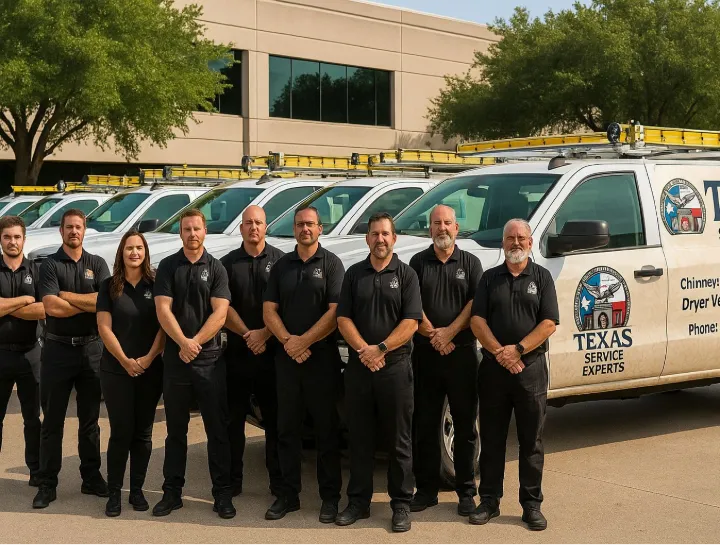
We've worked on 1,000+ DFW homes over 10+ years. Every job — small sweep or full rebuild — runs the same way: certified technicians, written quotes, photo reports, warranty in writing.
Metered diagnosis — reads the millivolt, not a guess
Replaces the failed part on your existing system
Correct thermocouple/thermopile/igniter for your valve
Proven by releasing the knob — the pilot holds
Family-owned, CSIA-certified, NFPA 211–compliant. We're the team you call when you want it done right the first time — no rotating subcontractors, no upsell pressure, no surprises. Same techs, same trucks, same standard.
The NFPA recommends a Level 1 inspection every year, with a sweep once buildup reaches 1/8" of creosote — for a wood fireplace you actually use, that's about once a heating season. The neighborly part: since we're already on the roof, the same crew checks your dryer vent and caps the visit with a quick whole-home safety look, so one appointment covers what would otherwise be three.
Yes — our inspectors hold current CSIA (Chimney Safety Institute of America) certifications, verifiable in the CSIA member directory at csia.org, and we have NFI specialists for fireplace work. The same trained crew handles your chimney, fireplace, dryer-vent and air-duct needs, so you're not juggling four different contractors for one house.
Yes — 24/7 response (subject to crew availability) for active leaks, an animal trapped in the flue, post-fire damage, and storm damage, same-day in most cases. One call reaches one crew that can handle whatever the situation turns out to need, instead of bouncing you between specialists while the water's still coming in.
Always — a written quote before we lift a tool, with photos of what we found, so you see exactly what you're approving. If the same visit turns up something in the dryer vent or ducts, it goes on one itemized quote and one invoice rather than a string of separate trips.
The Whole-Home Care Plan is our annual maintenance plan at $19.99/month ($240/year): a Level 1 inspection and sweep ($248 value), priority scheduling, 10% off all repairs, and emergency-response priority. Because one crew covers chimney, fireplace, dryer-vent and ducts, the plan keeps the whole house on a single schedule instead of a calendar full of separate service calls. Cancel anytime, no contract.
Last reviewed:
Other services in the Gas & Fireplace category.
Free written quote. Same-week scheduling. 24/7 emergency response when you need it.
Active leak, animal in flue, post-fire damage, or smoke event? Real humans on the line 7 AM to 12 AM every day — replies in under 2 minutes. Tech dispatch within 2 hours during business hours, subject to crew availability after-hours.
Emergency line