
Gas Fireplace Repair
Pilot won't hold, no heat, gas smell — diagnosed and repaired in one trip.
Learn moreElectric fireplaces fail in predictable ways — burnt heater elements, tired blower motors, dead remotes, flickering flame effects, a flaky control board — and we diagnose and repair all of them. Since we already cover your fireplace, venting, and home-comfort systems, it's the same trusted crew you call for everything else, so a quick repair like this can ride along with whatever else is on your list rather than becoming its own errand.
An electric fireplace almost never fails all at once — it loses one function. The heat quits but the flames still dance, or the flames die while the heater roars, or the remote stops talking to a unit that otherwise works fine. That's the tell that this is electronics-and-airflow work, not combustion work, and it rewards a technician who knows which module drives which behavior. Texas Service Experts diagnoses an electric fireplace down to the failed part rather than condemning the whole appliance — finding the cause before quoting the cure, the way you'd want a neighbor who actually knows the unit to handle it.
The diagnosis follows the unit's two independent circuits, because that split is what makes electric repair tractable. Flames without heat point at the heater side: a failed PTC ceramic element, a dead blower, or — most often — an auto-reset thermal cut-off that tripped behind a dust-clogged intake screen. Heat without flames points the other way: the LED board, the rotisserie flame rod, or the small motor that turns it. We meter each circuit, clear the airway that nuisance-trips the resettable cut-off, and replace only the module that actually failed — and where a unit has a blown one-time thermal fuse (the non-resettable backstop), that part is replaced, not reset. How this differs from electric-fireplace-installation: there's no rough opening, no dedicated circuit to pull, and no trim to set — the framing and power are already there and we leave them alone, so the entire job happens inside the unit.
Their own category — and the one homeowners most often mistake for a dead fireplace — is control and signal faults. When a unit ignores its remote, the cause is usually a flat remote battery, a lost RF pairing, or a failed receiver board, not house wiring. We re-pair or swap the remote first, and only if the unit ignores its manual buttons too do we go after the internal control board. On the smart units now shipping with Wi-Fi modules and app control, we troubleshoot the connectivity board and firmware handshake rather than guessing at the power side.
With no flue and no gas in play, the safety work here is purely electrical, and we treat the unit as live until proven otherwise. The breaker and supply get confirmed before anything opens, the unit is isolated from the mains before we touch the element or board, and we check that a tripping breaker is a genuine fault rather than a unit sharing an overloaded circuit it was never meant to share. Internal repairs sit on the wrong side of mains voltage and a hot element — which is precisely why the inside of the cabinet is technician territory, not a DIY afternoon.
On an electric unit the honest answer is often 'this is worth fixing,' and we'll say so plainly. A heating element, blower, flame motor, LED board, or receiver costs a fraction of a new built-in or mid-range fireplace, and swapping one part restores the whole unit. When a repair genuinely isn't cost-effective — a discontinued unit with an unobtainable proprietary board, say — we tell you that instead of selling a part that won't outlast the rest of the cabinet.
Doing it right means you get the diagnosis before the invoice and the real part instead of a parts-cannon. We isolate the fault, show you which component failed and why, replace it, and then cycle the heater and flame independently to confirm both circuits are healthy before we leave — and since the same crew handles the rest of your home, it's easy to have them glance at the dryer vent or ducts while they're already here, rather than booking another visit.
With our crew, a electric fireplace repair is never guesswork. We scope every job from a graded, photographed inspection first — the NFPA 211 level the evidence calls for — so the work is matched to what your flue and masonry actually need, with the report to prove it. The documented inspection is the record the electric fireplace repair is built on.
Chimney inspectionWe meter both circuits and pin down the failed component with the unit de-energized.
We name the part and give you a clear repair-versus-replace recommendation.
We swap the failed element, motor, board, or receiver, leaving the framing untouched.
We cycle the heater and flame separately and confirm the whole thing runs safe.
We've worked on 1,000+ DFW homes over 10+ years. Every job — small sweep or full rebuild — runs the same way: certified technicians, written quotes, photo reports, warranty in writing.
Traced down to the one failed module, so we're not condemning the whole unit
Both circuits: heater/blower/element and flame motor/LED board
Re-pairs remotes and fixes receiver/control boards
A straight repair-versus-replace call on the unit you already have
Family-owned, CSIA-certified, NFPA 211–compliant. We're the team you call when you want it done right the first time — no rotating subcontractors, no upsell pressure, no surprises. Same techs, same trucks, same standard.
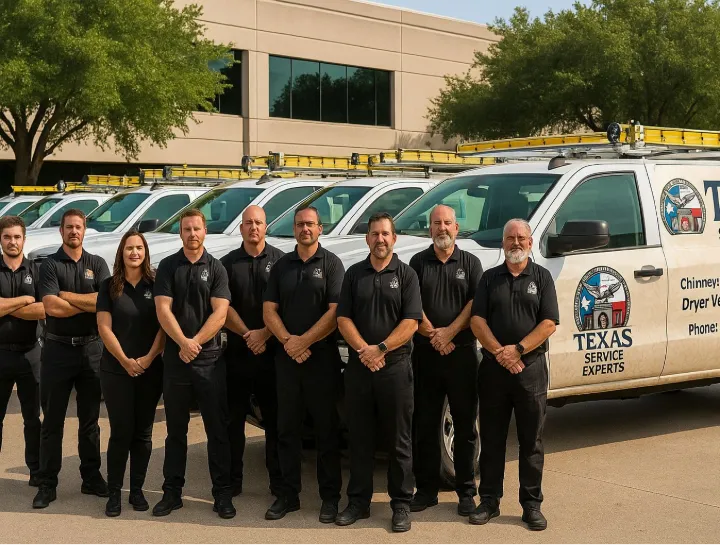
The NFPA recommends a Level 1 inspection every year, with a sweep once buildup reaches 1/8" of creosote — for a wood fireplace you actually use, that's about once a heating season. The neighborly part: since we're already on the roof, the same crew checks your dryer vent and caps the visit with a quick whole-home safety look, so one appointment covers what would otherwise be three.
Yes — our inspectors hold current CSIA (Chimney Safety Institute of America) certifications, verifiable in the CSIA member directory at csia.org, and we have NFI specialists for fireplace work. The same trained crew handles your chimney, fireplace, dryer-vent and air-duct needs, so you're not juggling four different contractors for one house.
Yes — 24/7 response (subject to crew availability) for active leaks, an animal trapped in the flue, post-fire damage, and storm damage, same-day in most cases. One call reaches one crew that can handle whatever the situation turns out to need, instead of bouncing you between specialists while the water's still coming in.
Always — a written quote before we lift a tool, with photos of what we found, so you see exactly what you're approving. If the same visit turns up something in the dryer vent or ducts, it goes on one itemized quote and one invoice rather than a string of separate trips.
The Whole-Home Care Plan is our annual maintenance plan at $19.99/month ($240/year): a Level 1 inspection and sweep ($248 value), priority scheduling, 10% off all repairs, and emergency-response priority. Because one crew covers chimney, fireplace, dryer-vent and ducts, the plan keeps the whole house on a single schedule instead of a calendar full of separate service calls. Cancel anytime, no contract.
Last reviewed:
Other services in the Gas & Fireplace category.
Free written quote. Same-week scheduling. 24/7 emergency response when you need it.
Active leak, animal in flue, post-fire damage, or smoke event? Real humans on the line 7 AM to 12 AM every day — replies in under 2 minutes. Tech dispatch within 2 hours during business hours, subject to crew availability after-hours.
Emergency line