
Air Duct Services
Beyond cleaning — duct repair, mastic sealing, sanitizing, and replacement.
Learn moreAn under-insulated attic is the single biggest reason a Texas home is hard to keep comfortable and expensive to run. We blow in cellulose or fiberglass to R-38 (Texas code) or R-49 (DOE recommended), with proper baffles, a dam, and an access platform done right. It's the comfort upgrade that ties everything else together — pair it with duct sealing and damper work and one crew can tighten up the whole home's efficiency in a coordinated visit, so every system you've invested in actually holds its temperature.
Blown-in is a method, not a menu — and the method is what determines whether the R-value on the bag ever reaches your attic floor. Loose fill is fed through a hopper, fluffed with air, and hosed across the deck through a long fill tube, building up an even blanket that drapes around joists, wiring runs, and the irregular framing a rigid batt can never sit flush against. That conformability is the whole reason loose fill exists: it has no seams, no friction-fit gaps, and no cut-to-fit waste. Texas Service Experts installs it the way the coverage chart demands — to the bag count AND the settled depth, not whichever runs out first.
Material choice changes the numbers, and we choose by the attic, not by what's on the truck. Cellulose delivers roughly R-3.7 per inch, packs denser, and resists air movement through the blanket better — but it's heavier and settles more, so we over-blow it to account for the drop. Loose-fill fiberglass runs about R-2.5 per inch, weighs less, settles barely at all, and won't wick water if the attic ever leaks — but at low density it lets more air drift through, so we blow it to the higher install depth its chart specifies. Hitting R-38 to R-49 means a real, different installed depth for each: a cellulose job and a fiberglass job to the same R-value aren't the same height of fill, and a crew that ignores that under-delivers one of them.
Density and depth verification are the craft. We dial the machine for the target install density — under-fluffed cellulose blows light and settles into a thin, cold blanket; over-packed fiberglass wastes material and can lose loft. We over-blow above the final R-target so that when loose fill settles in its first weeks the SETTLED depth still meets spec, and we staple depth-marker rulers every few feet across the deck so the installed inches are a measurement you can read yourself, not a promise. We dam and baffle the eaves so the blower doesn't drift fill into the soffit vents and so wind-washing can't thin the perimeter blanket. How this differs from insulation-services: this page is the loose-fill blow itself — the one installation method — while that umbrella service decides whether blowing, batt, or spray is even the right answer and air-seals the envelope first.
One honest limit defines this method: loose fill is a conductive barrier, not an air barrier. Blown over an unsealed attic it simply filters the air still leaking through every top-plate gap and penetration, which is why we flag air-sealing as a prerequisite rather than pretend the blanket fixes leakage. We blow over existing fill when it's dry and intact (a top-off to depth), and we re-fluff or re-level settled, matted, or foot-traffic-crushed fill that's lost its rated loft. The value is in the gauge readings, the over-blow math, and the documented settled depth — getting the method exactly right, every square foot.
Because it's one standards-driven crew, the machine-density settings and over-blow allowance are tuned to the local climate zone and the chosen material's coverage chart — and since the same team handles the air-sealing, the chimney chase, and the attic vents, the insulation is installed as part of a whole, coordinated envelope rather than a one-off attic blow. You're not trusting a stranger to eyeball the hopper; you're getting the crew that already knows your house, on the one thing this service is: loose fill, blown to a proven depth.
For a machine-blown, density-correct, depth-verified loose-fill install, call (214) 444-8094.
We choose the material and read its coverage chart to hit the target depth and density.
Dam eaves and protect soffit vents before blowing.
Machine-blow to install depth, over-blown for settling.
Verify settled depth against stapled depth-marker rulers.
We've worked on 1,000+ DFW homes over 10+ years. Every job — small sweep or full rebuild — runs the same way: certified technicians, written quotes, photo reports, warranty in writing.
Cellulose (~R-3.7/in) or fiberglass (~R-2.5/in), blown to the depth the coverage chart calls for
Blown a touch heavy to allow for settling, so the settled depth still lands on target
Machine density dialed in, not eyeballed
Depth-marker rulers prove the installed inches
Family-owned, CSIA-certified, NFPA 211–compliant. We're the team you call when you want it done right the first time — no rotating subcontractors, no upsell pressure, no surprises. Same techs, same trucks, same standard.
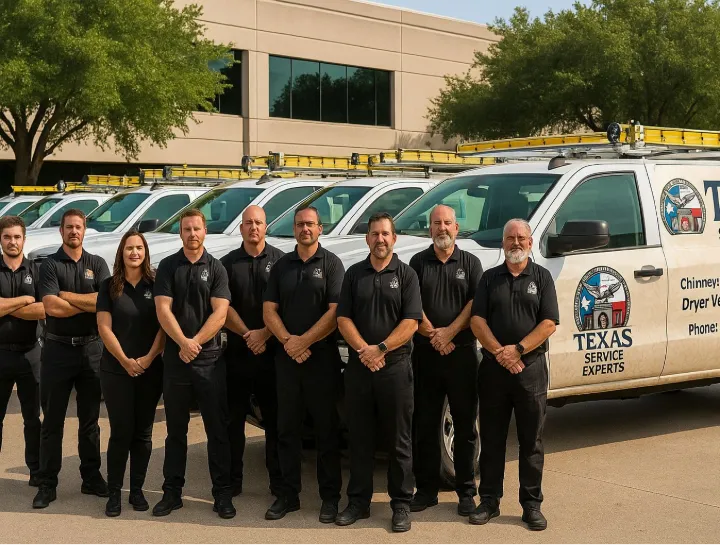
The NFPA recommends a Level 1 inspection every year, with a sweep once buildup reaches 1/8" of creosote — for a wood fireplace you actually use, that's about once a heating season. The neighborly part: since we're already on the roof, the same crew checks your dryer vent and caps the visit with a quick whole-home safety look, so one appointment covers what would otherwise be three.
Yes — our inspectors hold current CSIA (Chimney Safety Institute of America) certifications, verifiable in the CSIA member directory at csia.org, and we have NFI specialists for fireplace work. The same trained crew handles your chimney, fireplace, dryer-vent and air-duct needs, so you're not juggling four different contractors for one house.
Yes — 24/7 response (subject to crew availability) for active leaks, an animal trapped in the flue, post-fire damage, and storm damage, same-day in most cases. One call reaches one crew that can handle whatever the situation turns out to need, instead of bouncing you between specialists while the water's still coming in.
Always — a written quote before we lift a tool, with photos of what we found, so you see exactly what you're approving. If the same visit turns up something in the dryer vent or ducts, it goes on one itemized quote and one invoice rather than a string of separate trips.
The Whole-Home Care Plan is our annual maintenance plan at $19.99/month ($240/year): a Level 1 inspection and sweep ($248 value), priority scheduling, 10% off all repairs, and emergency-response priority. Because one crew covers chimney, fireplace, dryer-vent and ducts, the plan keeps the whole house on a single schedule instead of a calendar full of separate service calls. Cancel anytime, no contract.
Last reviewed:
Other services in the Home Services category.
Free written quote. Same-week scheduling. 24/7 emergency response when you need it.
Active leak, animal in flue, post-fire damage, or smoke event? Real humans on the line 7 AM to 12 AM every day — replies in under 2 minutes. Tech dispatch within 2 hours during business hours, subject to crew availability after-hours.
Emergency line