
Custom Masonry Fireplace Build (Rumford)
A from-scratch masonry fireplace, including Rumford designs, engineered to draft.
Learn moreA factory-built firebox is only as safe as its installation, and the install spans framing, venting, and clearances — work most homeowners would otherwise split between trades. We set UL-listed zero-clearance fireboxes strictly to their listing: chase framed to the manufacturer's dimensions, clearances to combustibles held to the inch, a matched Class-A chimney run with firestops at each floor and a 3-2-10 termination, and outside air ducted where the home is tight. One crew owns the whole listed system — we don't improvise listed venting — so it goes in right the first time.
A factory-built, zero-clearance firebox is the smart way to add a real wood- or gas-burning fireplace to a framed wall — but it's only as good as the installation. These are UL-listed appliances with exact clearance, chase, and venting requirements, and the difference between a safe, efficient install and a fire-hazard one is entirely in the craftsmanship. Texas Service Experts installs zero-clearance fireboxes strictly to their listing.
The phrase 'zero clearance' is misleading and dangerous if taken literally. Every listed firebox specifies precise clearances to framing, a required chase construction, and a specific Class-A chimney system — and those numbers aren't suggestions. We frame the chase to the manufacturer's dimensions, set the firebox so its listed clearances to combustibles are held exactly, and run the matching Class-A insulated chimney straight up with correct support, firestops at each floor, and a proper roof penetration. Mixing brands of pipe, fudging a clearance, or skipping a firestop is how a 'code' install becomes a slow-cook fire risk.
Draft and combustion air get that same discipline. We run the chimney to the required height above the roof for the 3-2-10 clearance rule so embers clear the roof safely, with the overall flue height sized for a clean draw, and where the home is tight or code requires it, we duct outside combustion air to the unit so it doesn't pull makeup air — and smoke — from the room. On gas models, the connection is made and leak-tested. The chase, cricket, and termination are built like the rest of the home: a back-side roof cricket so water sheds around the chimney, every penetration flashed, and the chase capped with a sloped stainless cover and an appropriate cap or shroud.
Inside, the firebox is set plumb and the surround detailed to your design, with the listed non-combustible clearances around the opening honored to the inch. Planning a flat-screen above? We install a proper mantel/heat deflector so the listing — and your TV — are respected. A zero-clearance install typically runs a few days; we leave you a documentation package with clearance photos, the gas test where applicable, and the termination detail, and we pull the permit and schedule the inspection.
With our crew, a zero-clearance firebox installation is never guesswork. We scope every job from a graded, photographed inspection first — the NFPA 211 level the evidence calls for — so the work is matched to what your flue and masonry actually need, with the report to prove it. The documented inspection is the record the zero-clearance firebox installation is built on.
Chimney inspectionA zero-clearance firebox installation isn't a matter of opinion — it's held to published national standards. Texas Service builds every job to the named codes below and documents it, so the work is provably right for an inspector, an insurer, or a future buyer. These are the universal standards; your city's permit and inspection requirements are confirmed with the local authority before we pull the job.
Zero clearance describes the engineered design of a UL-listed firebox, not a green light to frame against it; each model lists exact framing clearances, and we hold every one precisely.
A listed firebox keeps its rating only with the Class-A chimney specified for it; mix brands or components and both the listing and the safety margin are gone, so we run the matched system with correct supports and firestops.
We terminate the chimney at least 3 ft above the roof penetration and 2 ft above anything within 10 ft, a fire-and-ember clearance rule; the draft itself depends on overall flue height and correct sizing rather than that termination height.
At every ceiling and floor the chimney passes through, required firestop spacers go in so clearance to combustibles holds along the entire run.
Codes cited are the established national standards (NFPA, UL, IRC) that govern this service. The adopted code edition, permit, and inspection requirements vary by city —Texas Service verifies them with your local authority having jurisdiction on every job.
Frame the chase to the unit's listed dimensions and set the firebox while holding exact clearances.
Install the matched Class-A system with firestops at every floor and a 3-2-10 termination.
Build the roof cricket, flash the penetrations, and cap it with a sloped stainless cover and shroud.
Duct outside air where it is needed, leak-test any gas model, set the surround, and document clearances.
We've worked on 1,000+ DFW homes over 10+ years. Every job — small sweep or full rebuild — runs the same way: certified technicians, written quotes, photo reports, warranty in writing.
Chase framed to the manufacturer's dimensions, with clearances to combustibles held exactly
A matched Class-A chimney with firestops and a 3-2-10 termination, never mixed pipe
Roof cricket, full flashing, and a sloped stainless chase cover and cap
Outside-air duct and TV heat-deflector detailing wherever the listing calls for it
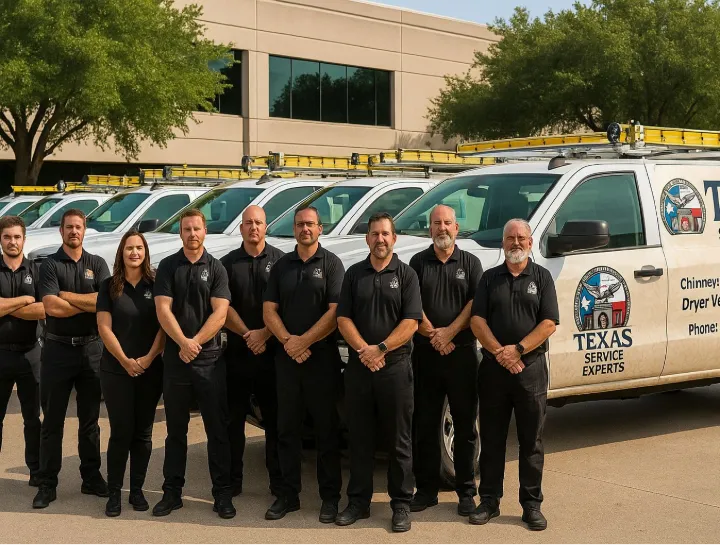
Family-owned, CSIA-certified, NFPA 211–compliant. We're the team you call when you want it done right the first time — no rotating subcontractors, no upsell pressure, no surprises. Same techs, same trucks, same standard.
The NFPA recommends a Level 1 inspection every year, with a sweep once buildup reaches 1/8" of creosote — for a wood fireplace you actually use, that's about once a heating season. The neighborly part: since we're already on the roof, the same crew checks your dryer vent and caps the visit with a quick whole-home safety look, so one appointment covers what would otherwise be three.
Yes — our inspectors hold current CSIA (Chimney Safety Institute of America) certifications, verifiable in the CSIA member directory at csia.org, and we have NFI specialists for fireplace work. The same trained crew handles your chimney, fireplace, dryer-vent and air-duct needs, so you're not juggling four different contractors for one house.
Yes — 24/7 response (subject to crew availability) for active leaks, an animal trapped in the flue, post-fire damage, and storm damage, same-day in most cases. One call reaches one crew that can handle whatever the situation turns out to need, instead of bouncing you between specialists while the water's still coming in.
Always — a written quote before we lift a tool, with photos of what we found, so you see exactly what you're approving. If the same visit turns up something in the dryer vent or ducts, it goes on one itemized quote and one invoice rather than a string of separate trips.
The Whole-Home Care Plan is our annual maintenance plan at $19.99/month ($240/year): a Level 1 inspection and sweep ($248 value), priority scheduling, 10% off all repairs, and emergency-response priority. Because one crew covers chimney, fireplace, dryer-vent and ducts, the plan keeps the whole house on a single schedule instead of a calendar full of separate service calls. Cancel anytime, no contract.
Last reviewed:
Other services in the New Construction & Outdoor category.
Free written quote. Same-week scheduling. 24/7 emergency response when you need it.
Active leak, animal in flue, post-fire damage, or smoke event? Real humans on the line 7 AM to 12 AM every day — replies in under 2 minutes. Tech dispatch within 2 hours during business hours, subject to crew availability after-hours.
Emergency line