
Chimney Liner
Reline the flue once, correctly — the foundation the rest of the system relies on.
Learn moreA smoke chamber that was built wrong or has fallen apart fights your fire every time you light it, dragging down draft and packing on creosote. We rebuild it to NFPA 211 spec with smooth refractory parging that lets the fire draw the way it should. As a structural fix inside the system, it pairs cleanly with relining or restoration work, so one crew can bring the whole flue path to spec in a single coordinated project rather than reopening the chimney twice.
A rebuild is what you do when the smoke chamber's structure has failed, not just its finish. The chamber is the corbeled funnel that steps brick inward to neck the firebox down to the flue, and when those courses collapse, slip out of plane, or were laid with a lopsided slope and oversized throat from day one, no amount of parging will fix it — the geometry itself is wrong. Texas Service Experts treats this as the reconstruction it is: we take the failed masonry down and build the funnel back correct, because a chamber that's the wrong shape will smoke and overheat no matter how smooth you trowel it. How this differs from smoke-chamber-repair: repair restores the skin on a chamber whose corbel is still sound; a rebuild replaces the corbel itself when it isn't.
Working through the damper throat, we open the chamber, document the failure, and demolish back to sound, anchorable masonry — spalled and fire-cracked brick, displaced corbel courses, a slumped or holed smoke shelf all come out. The stepped walls are then rebuilt in medium-duty firebrick set in refractory mortar, re-establishing the symmetrical inward corbel and the correct wall angle (held inside roughly 45 degrees off vertical so draft isn't choked) and sizing the throat to the flue above. Where brick-by-brick access is impossible, we form the chamber as a cast refractory pour instead — same corrected geometry, monolithic rather than coursed. This is layout and structural masonry in a confined space, which is exactly why it's a multi-day job and not an afternoon patch.
Geometry is the whole point of a rebuild, and it's what a patch can never reach. An offset or asymmetrical chamber, a throat far wider than the flue it feeds, a wall that steps in too steeply — those are original construction defects that strangle draft and dump heat against the masonry, and they only get corrected by taking the courses apart and re-laying them true. After a chimney fire that's spalled and shifted the brick, the chamber often has to be rebuilt anyway because the bond is gone. We re-form the smoke shelf at the base of the rebuild so it catches downdraft and debris the way it's meant to, then parge the new corbel smooth as the final step — on a rebuild, parging finishes the work, it isn't the work.
Because this is structural refractory masonry, it cures before it burns. We let the refractory mortar or cast form set through its required window, then call for a gradual break-in fire rather than a full hot load, so the new chamber tempers instead of cracking. We hand back a Level 2-grade record of what was demolished and what was rebuilt, sized and squared to the flue, laid to the code-correct funnel shape. When the structure of the fire's first transition has failed, rebuilding it right is the only honest fix — and because one crew owns the chamber, the flue above it, and the firebox below, the rebuild is coordinated with the rest of the system rather than left as an orphaned specialty job.
With our crew, a smoke chamber rebuild is never guesswork. We scope every job from a graded, photographed inspection first — the NFPA 211 level the evidence calls for — so the work is matched to what your flue and masonry actually need, with the report to prove it. The documented inspection is the record the smoke chamber rebuild is built on.
Chimney inspectionA smoke chamber rebuild isn't a matter of opinion — it's held to published national standards. Texas Service builds every job to the named codes below and documents it, so the work is provably right for an inspector, an insurer, or a future buyer. These are the universal standards; your city's permit and inspection requirements are confirmed with the local authority before we pull the job.
Smoke-chamber walls have to be parged smooth under NFPA 211. In a rebuild, the corbeled brick is re-laid to the correct funnel shape before any parging happens, which puts the streamlined profile on sound geometry instead of a patched one.
Because the rebuilt corbel sits in the hottest stretch of the heat path above the firebox, where standard gray mortar fails, the chamber is reconstructed in heat-rated firebrick and refractory mortar, or as a cast refractory form.
Laying the new corbel to a symmetrical inward slope necks the firebox down to the flue size and recovers the transition geometry an overbuilt or collapsed chamber lost. That is a structural correction no surface repair can deliver.
Once the refractory mortar or cast form has cured, the first fire is a gradual break-in burn rather than a full hot load, letting the reconstructed masonry temper instead of cracking.
Codes cited are the established national standards (NFPA, UL, IRC) that govern this service. The adopted code edition, permit, and inspection requirements vary by city —Texas Service verifies them with your local authority having jurisdiction on every job.
We run a camera and a hands-on look at the collapse and how the corbel is sitting.
We strip out failed brick, the courses that have shifted, and a wrecked smoke shelf, back to solid masonry.
We re-lay the corbel in firebrick and refractory, or cast it, squared true to the flue throat.
We smooth-coat and cure the refractory, then walk you through a gradual break-in fire before full use.
We've worked on 1,000+ DFW homes over 10+ years. Every job — small sweep or full rebuild — runs the same way: certified technicians, written quotes, photo reports, warranty in writing.
Full demolition and reconstruction, not a surface patch
Corbel geometry and throat re-sized true to the flue
Firebrick-and-refractory or cast-form rebuild to suit access
Cured and break-in fired before your first real burn, logged to a Level 2-grade record
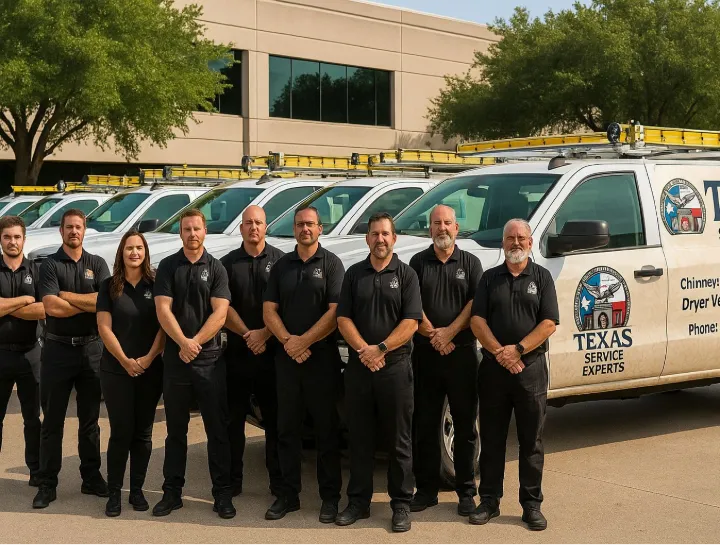
Family-owned, CSIA-certified, NFPA 211–compliant. We're the team you call when you want it done right the first time — no rotating subcontractors, no upsell pressure, no surprises. Same techs, same trucks, same standard.
The NFPA recommends a Level 1 inspection every year, with a sweep once buildup reaches 1/8" of creosote — for a wood fireplace you actually use, that's about once a heating season. The neighborly part: since we're already on the roof, the same crew checks your dryer vent and caps the visit with a quick whole-home safety look, so one appointment covers what would otherwise be three.
Yes — our inspectors hold current CSIA (Chimney Safety Institute of America) certifications, verifiable in the CSIA member directory at csia.org, and we have NFI specialists for fireplace work. The same trained crew handles your chimney, fireplace, dryer-vent and air-duct needs, so you're not juggling four different contractors for one house.
Yes — 24/7 response (subject to crew availability) for active leaks, an animal trapped in the flue, post-fire damage, and storm damage, same-day in most cases. One call reaches one crew that can handle whatever the situation turns out to need, instead of bouncing you between specialists while the water's still coming in.
Always — a written quote before we lift a tool, with photos of what we found, so you see exactly what you're approving. If the same visit turns up something in the dryer vent or ducts, it goes on one itemized quote and one invoice rather than a string of separate trips.
The Whole-Home Care Plan is our annual maintenance plan at $19.99/month ($240/year): a Level 1 inspection and sweep ($248 value), priority scheduling, 10% off all repairs, and emergency-response priority. Because one crew covers chimney, fireplace, dryer-vent and ducts, the plan keeps the whole house on a single schedule instead of a calendar full of separate service calls. Cancel anytime, no contract.
Last reviewed:
Other services in the Repair category.
Free written quote. Same-week scheduling. 24/7 emergency response when you need it.
Active leak, animal in flue, post-fire damage, or smoke event? Real humans on the line 7 AM to 12 AM every day — replies in under 2 minutes. Tech dispatch within 2 hours during business hours, subject to crew availability after-hours.
Emergency line