
Chimney Inspection
A thorough safety + code check that maps every issue in one walk-through.
Learn moreA chimney leak almost never enters where the stain shows up, which is why so many homeowners pay to "fix" it twice. We trace water to its true exterior entry point with moisture metering and zoned hose testing before quoting a single repair — and because we're the crew that also does the crown, flashing, masonry, and interior drywall, whatever we find, we can fix in the same relationship. One diagnosis, one team, the cause solved once with evidence instead of a guess.
A chimney leak almost never enters where it appears. The water stain on your ceiling, the damp firebox, the efflorescence blooming on interior brick — these are exit points, sometimes feet away from the actual breach. Texas Service Experts treats leak diagnosis as a discipline of evidence, not guesswork, because the wrong fix on a misdiagnosed leak is the most common reason homeowners pay twice. We trace the water to its true entry before we quote a single repair, and we will not seal a crown if the real culprit is the flashing. That refusal to guess is what makes the diagnosis worth paying for on its own.
Our diagnostic process is methodical. We start with a visual and moisture-meter survey of the usual suspects — crown cracks, failed flashing, deteriorated mortar joints, spalled brick, an unsealed masonry face, a missing or undersized cap. Then we isolate by zone: a controlled hose-down test that wets the crown alone, then the flashing alone, then the brick face alone, watching the interior between each stage until the leak reproduces. For elusive intrusions we add a dye trace. We follow the path from the interior stain back up the flue and structure to the exact exterior point of entry, documenting each step with the moisture readings and photos that prove the diagnosis. This is the difference between real diagnosis and a guess: you see why the water is getting in, not just where it ended up — and because one crew can then fix the crown, the flashing, the brick, and any soaked insulation it finds, the whole leak gets closed out in one coordinated job.
The interior clues count as much as the exterior ones, and we read them in sequence. A stain on the ceiling near the chimney chase, efflorescence blooming on interior brick, a rusting damper, a musty firebox — each points to a different entry zone, so we follow the path from symptom backward instead of starting at a guess. A damper rusted shut, for instance, is often the first evidence of water arriving from above, so freeing and inspecting it can be the step that exposes a crown or flashing failure we'd otherwise have to hunt for. We treat the chimney as a system water travels through, and trace the whole path, not just the nearest crack.
Once the source is confirmed, we lay out the right repair in plain terms — flashing reseal or replacement, crown sealing or recast, tuckpointing, breathable waterproofing, or a combination — with honest pricing and the reasoning behind each line. Because masonry chimneys absorb water and freeze-thaw cycles compound every untreated crack, a leak left to "watch" rarely stays small; we tell you what is urgent and what can wait. And because one crew owns every fix the diagnosis points to — flashing, crown, masonry, waterproofing, even the interior wall and the wet insulation behind it — you're not handing the report to three other contractors and hoping they agree. Find the source, fix it once, document it: the whole-home way to handle water.
With our crew, a chimney leak diagnosis is never guesswork. We scope every job from a graded, photographed inspection first — the NFPA 211 level the evidence calls for — so the work is matched to what your flue and masonry actually need, with the report to prove it. The documented inspection is the record the chimney leak diagnosis is built on.
Chimney inspectionA chimney leak diagnosis isn't a matter of opinion — it's held to published national standards. Texas Service builds every job to the named codes below and documents it, so the work is provably right for an inspector, an insurer, or a future buyer. These are the universal standards; your city's permit and inspection requirements are confirmed with the local authority before we pull the job.
When a crown leaks, the missing piece is usually the overhang, slope, or drip edge that should throw water clear of the brick; we confirm the crown really is the source before quoting any seal or recast.
Roofline flashing is the most common leak point, and our zoned test tells us whether it is the breach; done to code, that transition means woven step flashing with counter-flashing set into a masonry reglet, never surface tar.
Tracing the source, the survey checks two culprits: a missing cap, and a flue that falls short of the 3-2-10 rule (≥3 ft above the roof, ≥2 ft above anything within 10 ft), since either can drive water and downdraft.
Codes cited are the established national standards (NFPA, UL, IRC) that govern this service. The adopted code edition, permit, and inspection requirements vary by city —Texas Service verifies them with your local authority having jurisdiction on every job.
We run a visual and moisture-meter check across the crown, flashing, mortar, and brick face.
We wet each zone in turn with a hose-down test until the leak shows itself again.
We trace the path from the interior stain back to the exact spot it enters outside.
Documented findings + an honest, source-matched repair plan.
We've worked on 1,000+ DFW homes over 10+ years. Every job — small sweep or full rebuild — runs the same way: certified technicians, written quotes, photo reports, warranty in writing.
We pin down the problem before we quote, so nobody seals the wrong spot
Zoned hose-down test isolates the true entry point
Moisture metering + dye trace on elusive leaks
Documented findings with photos and a source-matched plan
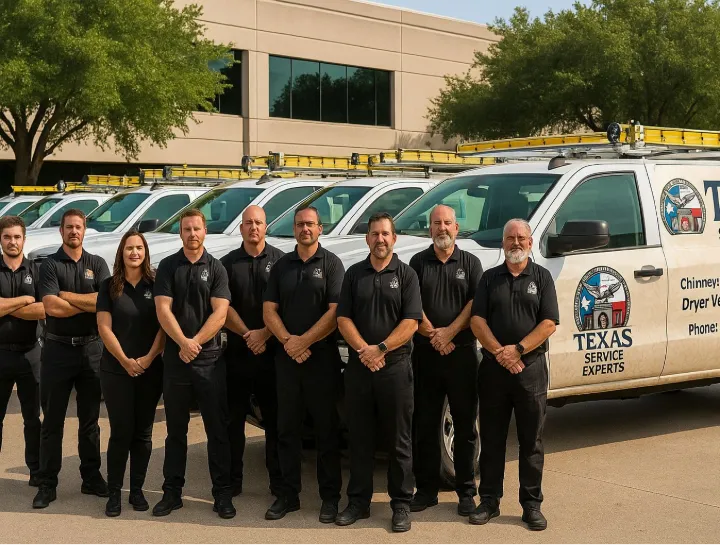
Family-owned, CSIA-certified, NFPA 211–compliant. We're the team you call when you want it done right the first time — no rotating subcontractors, no upsell pressure, no surprises. Same techs, same trucks, same standard.
The NFPA recommends a Level 1 inspection every year, with a sweep once buildup reaches 1/8" of creosote — for a wood fireplace you actually use, that's about once a heating season. The neighborly part: since we're already on the roof, the same crew checks your dryer vent and caps the visit with a quick whole-home safety look, so one appointment covers what would otherwise be three.
Yes — our inspectors hold current CSIA (Chimney Safety Institute of America) certifications, verifiable in the CSIA member directory at csia.org, and we have NFI specialists for fireplace work. The same trained crew handles your chimney, fireplace, dryer-vent and air-duct needs, so you're not juggling four different contractors for one house.
Yes — 24/7 response (subject to crew availability) for active leaks, an animal trapped in the flue, post-fire damage, and storm damage, same-day in most cases. One call reaches one crew that can handle whatever the situation turns out to need, instead of bouncing you between specialists while the water's still coming in.
Always — a written quote before we lift a tool, with photos of what we found, so you see exactly what you're approving. If the same visit turns up something in the dryer vent or ducts, it goes on one itemized quote and one invoice rather than a string of separate trips.
The Whole-Home Care Plan is our annual maintenance plan at $19.99/month ($240/year): a Level 1 inspection and sweep ($248 value), priority scheduling, 10% off all repairs, and emergency-response priority. Because one crew covers chimney, fireplace, dryer-vent and ducts, the plan keeps the whole house on a single schedule instead of a calendar full of separate service calls. Cancel anytime, no contract.
Last reviewed:
Other services in the Inspection category.
Free written quote. Same-week scheduling. 24/7 emergency response when you need it.
Active leak, animal in flue, post-fire damage, or smoke event? Real humans on the line 7 AM to 12 AM every day — replies in under 2 minutes. Tech dispatch within 2 hours during business hours, subject to crew availability after-hours.
Emergency line