
Chimney Liner
Reline the flue once, correctly — the foundation the rest of the system relies on.
Learn moreIf water shows up on the ceiling near the chimney, the culprit is almost always the flashing where it penetrates the roof — and a bead of caulk there fails inside two years. We cut new reglets and install proper step plus counter-flashing, the only repair that actually lasts. Because we're already on the roof and reading the whole system, we'll flag anything else up there worth handling in the same trip, so you close out every roof-line leak path at once instead of chasing drips one storm at a time.
Flashing is the watertight transition where the chimney meets the roof, and it is the leak point homeowners least suspect and contractors most often botch. Done right, it is a two-part system: step flashing — individual L-shaped pieces woven course-by-course into the shingles up the sidewall — and counter-flashing set into a saw-cut reglet in the masonry and folded down over the step pieces. Done wrong, it is a bead of caulk smeared over a gap, which is exactly the "repair" that fails within a season and sends water into the structure. Texas Service Experts flashes chimneys as the layered, mechanical, watertight assembly it is meant to be, because no amount of waterproofing the brick helps if the roofline transition is open.
We diagnose first and repair to the right depth. A sound flashing system with a failed seal may need only the reglet reservoir re-tooled and re-sealed; a corroded or badly installed one has to come out entirely and be rebuilt — new step flashing woven into the shingles, new counter-flashing cut into a fresh reglet, lead or aluminum to suit the roof. We dress fatigued lead back down, solder copper and galvanized corners for a watertight non-caulk joint where the detail demands it, and drill weep holes where water is trapped in the masonry cavity. On a wide chimney, or one sitting in a roof dead-valley that ponds water, the real fix isn't more flashing — it's a cricket: a peaked metal or framed saddle on the uphill side that diverts water and debris around the stack instead of letting it dam against the back wall. Where the wood cant or substrate under the cricket has rotted, we replace it before re-metaling, because new flashing over rotted backing is a guaranteed callback.
The harder roof geometries are where flashing failures hide, and where a lot of contractors are out of their depth. A chimney sitting in a dead-valley — a low spot where two roof planes funnel water at it — will pond and leak no matter how clean the step flashing is, and the real remedy is a diverter that moves water away before it reaches the stack. Trapped water inside a masonry cavity needs weep holes drilled at the flashing line to drain it, or it just sits and finds another way in. A counter-flashing reglet needs its sealant tooled into a proper backed reservoir, not smeared across the surface, or it pulls away as the building moves. On a flat commercial roof, an irregular stack penetration may need a poured pitch pan rather than conventional flashing entirely. We diagnose the geometry, not just the metal, because the leak is usually a water-management problem the original flashing was never designed to solve.
This is detail work where craftsmanship is literally watertight or it isn't — there is no partial credit on a flashing joint. We document the condition, explain whether a reseal or a full replacement is honestly warranted, and build the transition to shed water for the long term rather than buy a season with sealant. Crickets get specified wherever chimney width or roof geometry demands one — never treated as an upsell. And because the same crew handles the brick, the cap, and the waterproofing, the roofline transition is fixed in concert with everything else the water was touching, in one visit, instead of leaving you to coordinate a roofer, a mason, and a chimney company yourself. Get the transition right and you've closed the leak point that defeats every other waterproofing measure.
With our crew, a chimney flashing repair is never guesswork. We scope every job from a graded, photographed inspection first — the NFPA 211 level the evidence calls for — so the work is matched to what your flue and masonry actually need, with the report to prove it. The documented inspection is the record the chimney flashing repair is built on.
Chimney inspectionA chimney flashing repair isn't a matter of opinion — it's held to published national standards. Texas Service builds every job to the named codes below and documents it, so the work is provably right for an inspector, an insurer, or a future buyer. These are the universal standards; your city's permit and inspection requirements are confirmed with the local authority before we pull the job.
Done to code, the flashing transition is a two-part assembly. Step flashing weaves course-by-course into the shingles, and counter-flashing sets into a saw-cut reglet in the masonry; a bead of roofing tar is neither of those things.
Wide chimneys and stacks sitting in a roof dead-valley get a cricket, also called a saddle, built on the up-slope side. It steers water and debris around the stack, and it is the accepted fix wherever roof slope and chimney width let water dam against the back wall.
Counter-flashing gets mechanically set and sealed into a backed reglet reservoir, which keeps the joint watertight as the building moves. Surface caulk, by contrast, pulls away within a season.
Codes cited are the established national standards (NFPA, UL, IRC) that govern this service. The adopted code edition, permit, and inspection requirements vary by city —Texas Service verifies them with your local authority having jurisdiction on every job.
Pinpoint the leak path at the chimney-to-roof junction.
Strip failed flashing and any tar patches.
New step + counter-flashing, set and sealed watertight.
Water-test the repair and document with photos.
We've worked on 1,000+ DFW homes over 10+ years. Every job — small sweep or full rebuild — runs the same way: certified technicians, written quotes, photo reports, warranty in writing.
Proper step + counter-flashing, not a tar band-aid
Counter-flashing set into the mortar joint
Stops the leak at the source, guaranteed
Coordinates with roof line for a clean finish
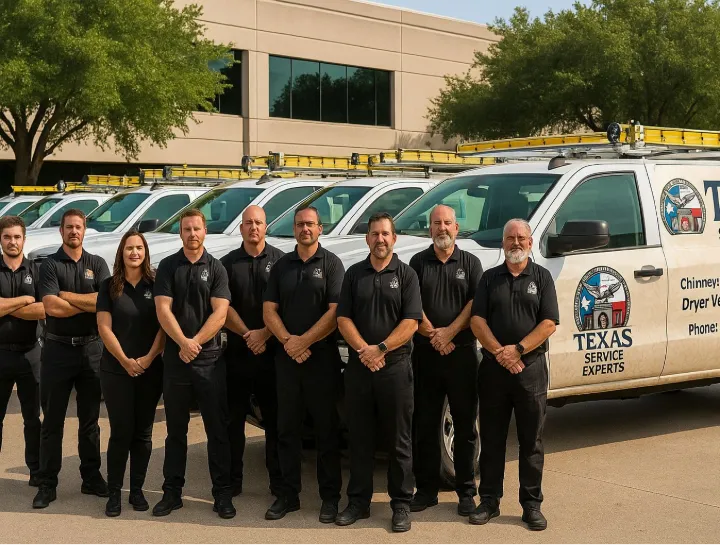
Family-owned, CSIA-certified, NFPA 211–compliant. We're the team you call when you want it done right the first time — no rotating subcontractors, no upsell pressure, no surprises. Same techs, same trucks, same standard.
The NFPA recommends a Level 1 inspection every year, with a sweep once buildup reaches 1/8" of creosote — for a wood fireplace you actually use, that's about once a heating season. The neighborly part: since we're already on the roof, the same crew checks your dryer vent and caps the visit with a quick whole-home safety look, so one appointment covers what would otherwise be three.
Yes — our inspectors hold current CSIA (Chimney Safety Institute of America) certifications, verifiable in the CSIA member directory at csia.org, and we have NFI specialists for fireplace work. The same trained crew handles your chimney, fireplace, dryer-vent and air-duct needs, so you're not juggling four different contractors for one house.
Yes — 24/7 response (subject to crew availability) for active leaks, an animal trapped in the flue, post-fire damage, and storm damage, same-day in most cases. One call reaches one crew that can handle whatever the situation turns out to need, instead of bouncing you between specialists while the water's still coming in.
Always — a written quote before we lift a tool, with photos of what we found, so you see exactly what you're approving. If the same visit turns up something in the dryer vent or ducts, it goes on one itemized quote and one invoice rather than a string of separate trips.
The Whole-Home Care Plan is our annual maintenance plan at $19.99/month ($240/year): a Level 1 inspection and sweep ($248 value), priority scheduling, 10% off all repairs, and emergency-response priority. Because one crew covers chimney, fireplace, dryer-vent and ducts, the plan keeps the whole house on a single schedule instead of a calendar full of separate service calls. Cancel anytime, no contract.
Last reviewed:
Other services in the Repair category.
Free written quote. Same-week scheduling. 24/7 emergency response when you need it.
Active leak, animal in flue, post-fire damage, or smoke event? Real humans on the line 7 AM to 12 AM every day — replies in under 2 minutes. Tech dispatch within 2 hours during business hours, subject to crew availability after-hours.
Emergency line